The "Invisible" Kitchen: Why Digital Marketing is the Oxygen of the Future F&B Industry
In my first article, Digital Marketing for 2026, we explored the "Answer Economy." In my second, F&B Social Media Trends, we discussed the "Sensory Revolution." Now, we arrive at the most critical question of all: The Business Case.
For decades, the F&B industry relied on three things: Location, Location, Location. If you had a good spot on a busy street, you made money.
In the future of F&B, your Digital Location matters more than your physical one. A customer decides to eat at your restaurant hours before they ever step foot inside. If you are not digitally visible, you are commercially invisible.
I will explain why F&B Digital Marketing is no longer an optional expense but the fundamental operating system of the modern restaurant—driving everything from revenue to menu design.
Reason 1: The "Digital Front Door" Concept
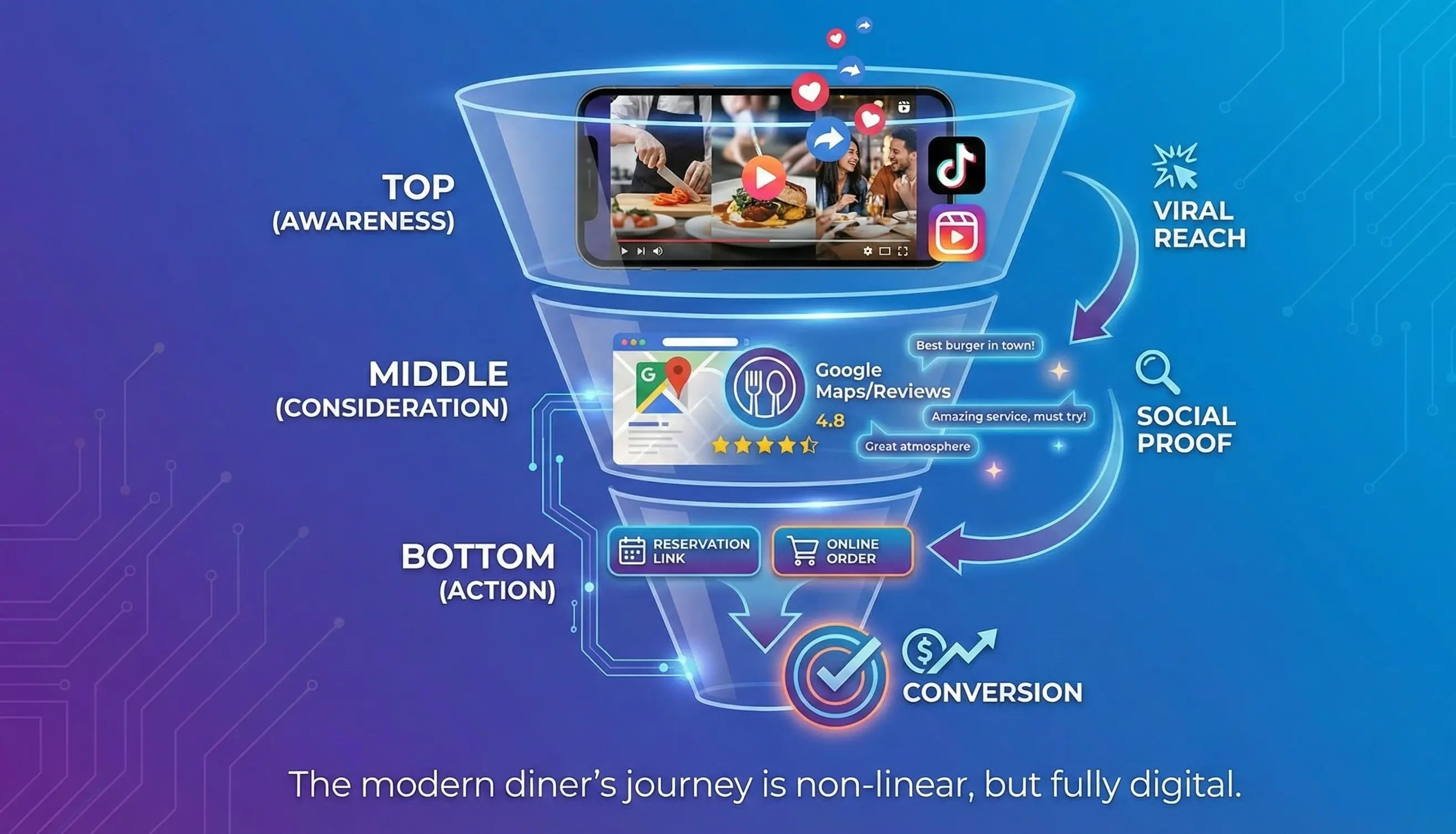
Your physical door is no longer your main entrance. Your Google Business Profile, Instagram Feed, and Website are the new front doors.
The Decision Happens on the Screen 90% of guests research a restaurant online before dining, more than any other business category. They check the menu, read the reviews, and look at the vibe on Instagram. If your digital presence is outdated, they assume your food is fresh? Unlikely.
Zero-Click Discovery As we discussed in the rise of Generative Engine Optimization (GEO), future customers might not even click your website. They will ask AI: "What is a romantic Italian spot in Bangkok with good wine?" If your digital signals (SEO, Reviews, Citations) aren't strong enough to convince the AI, you lose the customer without ever knowing they existed.
Reason 2: Data is the New Key Ingredient
The most dangerous phrase in F&B is "I think." "I think people like the pasta." "I think Tuesdays are slow." Digital Marketing replaces "I think" with "I know."
Menu Engineering via Analytics By analyzing social media engagement and website clicks, you can see which dishes people are obsessed with before they even order. If your "Truffle Burger" video gets 10x more shares than your "Caesar Salad," but nobody orders it, you know you have a pricing or placement problem, not a product problem.
Predictive Staffing Advanced digital tools can now predict foot traffic based on ad performance and reservations. This saves you thousands in wasted labor costs by preventing over-staffing on slow nights.
Data doesn't lie. People do. A menu without data is just a guess. Retention is cheaper than acquisition.
In the future of hospitality, the brands that win will be the ones that use Customer Lifetime Value (LTV) as their north star, not just daily sales.
Reason 3: The Economics of Retention (Loyalty Loop)
The old F&B model was Churn and Burn that gets as many heads in beds as possible. The future model is The Loyalty Loop.
The Cost of Acquisition It costs 7x more to acquire a new customer than to keep an existing one. Yet, most restaurants spend 100% of their budget on ads for new people.
Owned Channels are Gold Digital Marketing allows you to capture data (Emails, Phone Numbers). When you have a slow Tuesday, you don't need to pray for walk-ins. You send an SMS blast: "Free Appetizer for our VIPs tonight." You fill the room in 20 minutes for zero ad spend. This is the power of First-Party Data, which I highlighted as a key 2026 trend.
How to Build a "Digital Flywheel" for your Restaurant:
-
Capture: Use a QR code on the table or a Wi-Fi login to collect customer emails/phone numbers.
-
Nurture: Send automated, personalized emails on their birthday or anniversary (e.g., "Your table is ready, John").
-
Convert: Use retargeting ads to show them the new seasonal menu, tempting them back.
Digital Marketing solves these operational headaches:
-
Empty Seats: Fill gaps instantly with targeted "Happy Hour" ads.
-
Negative Reviews: mitigate bad press by responding quickly and burying negatives with positive SEO.
-
Inventory Waste: Promote perishable specials instantly to sell out before ingredients spoil.
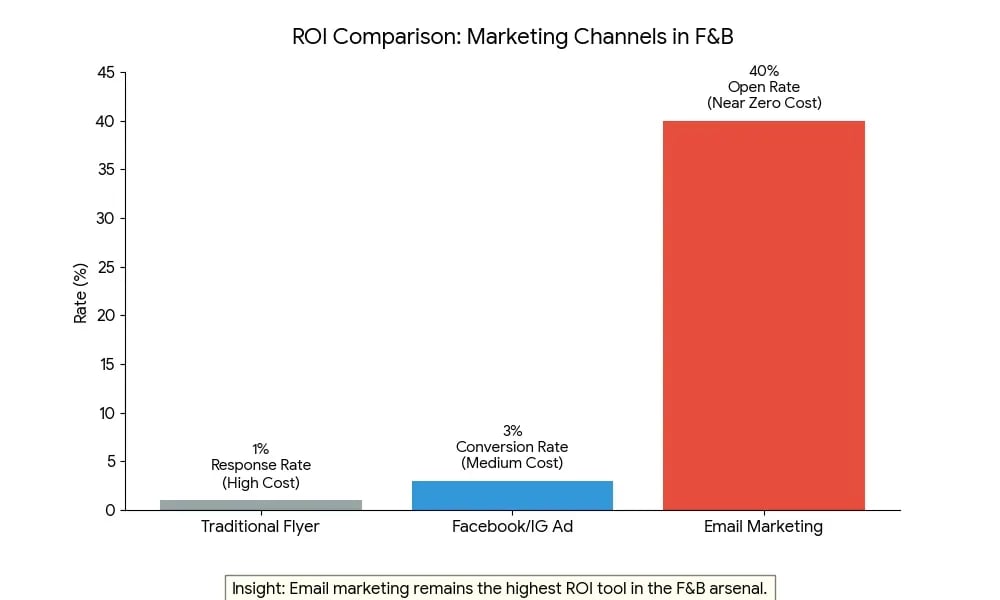
The chart visualizes the performance of Traditional Flyers, Facebook/IG Ads, and Email Marketing based on the provided metrics and costs.
Reason 4: Crisis Management & Reputation Defense
In the age of viral content, a brand can be built in a day and destroyed in an hour.
Control the Narrative If a customer posts a video of a bad experience, it can go viral before you even wake up. Digital Marketing gives you the tools (Social Listening) to detect these sparks before they become fires.
The "Trust Bank" By consistently publishing high-quality, transparent content (Farm-to-Table stories, Staff Spotlights), you build a "Bank of Trust." When a mistake eventually happens, your community is more likely to forgive you because they feel they know you.
"A restaurant without digital marketing is like a chef without a knife. You might have the best ingredients, but you can't serve the meal." — Ni Htoo Kyaw, F&B Digital Marketing Strategist & Analyst.
It's Not Marketing, It's Management
We need to stop calling it just 'advertising.' In the future, F&B Digital Marketing is simply Digital Management."
It is how you manage your reputation, your revenue, your customer relationships, and your future growth. The restaurants that view this as an "extra cost" will disappear. The ones that view it as an investment will dominate.
You have the vision for your brand. Now, you need the digital infrastructure to support it.
This concludes our three-part series on the Future of Digital Marketing. From understanding the Algorithm of 2026, to mastering Sensory Social Media, to building a Business Case for ROI, you now have the blueprint.
The only thing left to do? Start.