Introduction: The Death of the Human Screen
Let’s be honest about the exhaustion in the hospitality industry right now. You spent years mastering Facebook ads, only for them to get expensive. You pivoted to Instagram, only for the algorithm to demand Reels. You just figured out TikTok, and now I am telling you the game is changing again.
But this shift isn't just another social media platform. It is a fundamental rewiring of how commerce happens.
We are entering the era of Marketing 7.0.
To understand where we are going, look at where we came from. Marketing 1.0 was product-centric (sell the steak). Marketing 3.0 became human-centric (sell the experience). Marketing 5.0 brought technology for humanity (data-driven marketing), and 6.0 introduced the "Phygital" world (the blending of physical and digital spaces).
Marketing 7.0 is the era of the Autonomous Machine Customer.
In the next few years, the primary target of your F&B Digital Marketing will not just be a hungry human staring at a screen. It will be an Artificial Intelligence agent acting on behalf of that human.
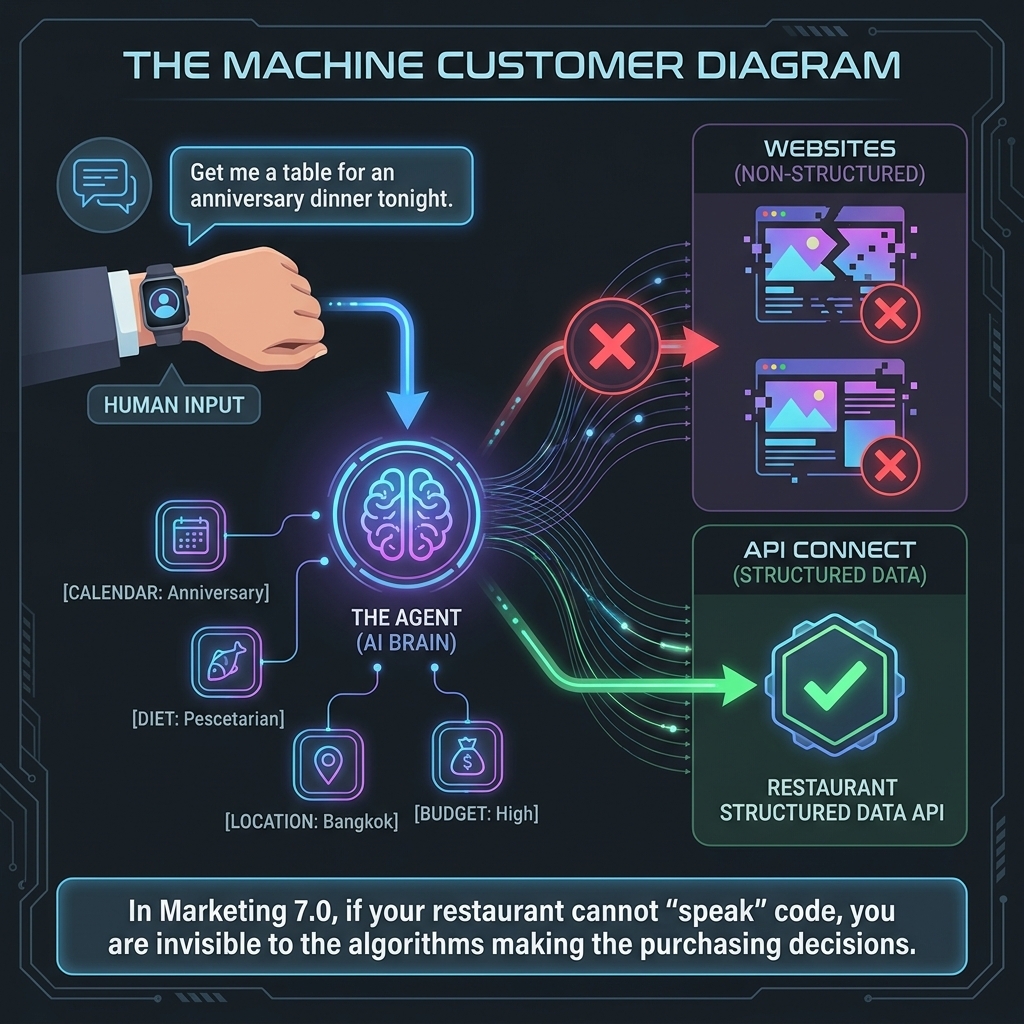
When a customer wants dinner, they won't open Google Maps or a delivery app to scroll through your photos. They will simply tell their AI assistant (like an advanced Siri, ChatGPT, or Google Gemini): "Book a table for two tonight at 8 PM somewhere in Sukhumvit. Make sure they have a good natural wine list and a gluten-free menu, and keep it under 3,000 Baht."
The AI will negotiate with other AIs, check reservations, verify menus, and book the table in milliseconds. If your restaurant’s digital infrastructure cannot "speak" to that AI, you will never even know you lost the customer.
As a Strategic Growth Analyst, my job is not to chase fleeting trends; it is to build systems that survive structural shifts. In this comprehensive guide, we will break down what Marketing 7.0 means for your restaurant, and the exact, practical steps you must take to survive the rise of Predictive Commerce.
Concept 1: The Rise of the "Machine Customer"
The most radical shift in F&B Digital Marketing is redefining who—or what—is doing the buying.
Gartner refers to this phenomenon as the "Machine Customer" (or Custobot). These are non-human economic actors that obtain goods and services in exchange for payment.
How it works in F&B: Imagine a smart refrigerator that tracks its inventory. It realizes you are out of your favorite local brand’s chili crisp. The fridge automatically interfaces with your bank, contacts the restaurant’s API, and orders a new jar for next-day delivery. The human was completely removed from the transaction.
In a dine-in context, the Machine Customer is the personal AI assistant. It knows the user’s calendar, dietary restrictions, past dining history, and budget.
The Marketing Problem: You cannot market to a Machine Customer with a funny TikTok dance. You cannot tempt an AI with a beautifully lit photo of a melting burger. AI does not have salivary glands. AI only reads data.
If your entire F&B Digital Marketing strategy relies on visual emotional manipulation, you are completely defenseless against the Machine Customer.
The Solution: API & Schema Optimization To sell to a machine, you must feed it structured data. This builds heavily on what we discussed in Blog 9: AI Search Optimization. You must have impeccable Schema Markup on your website.
- Your menu cannot be a PDF. It must be structured code.
- Your reservation system must have an open API so third-party agents can instantly ping it for availability.
- Your reviews must be aggregated and readable by machines to prove your "trustworthiness" score.
Concept 2: Predictive Hospitality (Anticipating the Craving)
Marketing 7.0 moves us from a reactive model to a predictive model.
Right now, F&B Digital Marketing works like this: A customer feels hungry (reaction), they search for food, and you try to intercept them.
Predictive Hospitality uses data to know the customer is going to be hungry before they even realize it themselves.
The "Zero-Second" Journey: By integrating data from wearables (smartwatches detecting a drop in blood sugar or completion of a heavy workout), calendar apps (knowing a 3-hour meeting just ended), and geolocation, AI can prompt the user at the exact perfect moment.
- AI Notification at 5:00 PM: "You just finished a difficult workout and missed lunch. You need protein. Your favorite Steakhouse is 5 minutes away and I secured a table for you. Tap to confirm."
How to Play This Game: You cannot access a user's smartwatch data directly. But you can build your own predictive engine using your CRM. As we mapped out in our Restaurant CRM Strategy Guide, if you track when a customer comes in, what they order, and how often they visit, you can build predictive models.
If John orders the Omakase set every third Friday of the month, your automated marketing shouldn't wait for him to book. On the third Wednesday, your system should automatically text him: "Hi John, Chef has reserved two seats for your usual Friday Omakase. Reply 'YES' to lock it in."
That is Marketing 7.0. It feels like magic, but it is just applied mathematics.
Concept 3: Hyper-Dynamic Pricing and Menus
Airlines and Uber have used dynamic pricing for a decade. A flight costs more on a Friday than a Tuesday. A ride costs more in the rain.
The F&B industry has been painfully slow to adopt this, clinging to static, printed menus. Marketing 7.0 demands Hyper-Dynamic Pricing, executed in real-time.
The "Digital Menu Board" Evolution: When a customer scans a QR code or opens your digital menu, what they see should be entirely dependent on who they are and what the current restaurant conditions are.
- Inventory-Driven Pricing: The algorithm notices you have 10 portions of Sea Bass left that will spoil by tomorrow. The digital menu automatically drops the price of the Sea Bass by 15% and pushes it to the "Chef's Recommendation" section at the very top of the screen.
- Weather-Driven Marketing: It starts pouring rain in Bangkok. Your F&B Digital Marketing system automatically activates a Google Ads campaign targeting a 1km radius offering a "Rainy Day Ramen Special" and updates your digital menu to highlight warm, comforting soups.
- LTV (Lifetime Value) Personalization: When your highest-spending VIP customer logs into the reservation portal, the system recognizes them. The menu they see hides the cheap entry-level wines and automatically highlights the premium vintages they usually buy.
This requires an advanced understanding of behavioral economics, which we touched upon in our Menu Psychology Framework. But instead of applying psychology to a piece of paper, we are applying it to a dynamic algorithm.
Concept 4: Spatial Computing and "Phygital" Dining
As we transition into the late stages of Marketing 6.0 and enter 7.0, the barrier between the physical restaurant and the digital space completely dissolves. This is driven by Spatial Computing (like the Apple Vision Pro or advanced AR glasses).
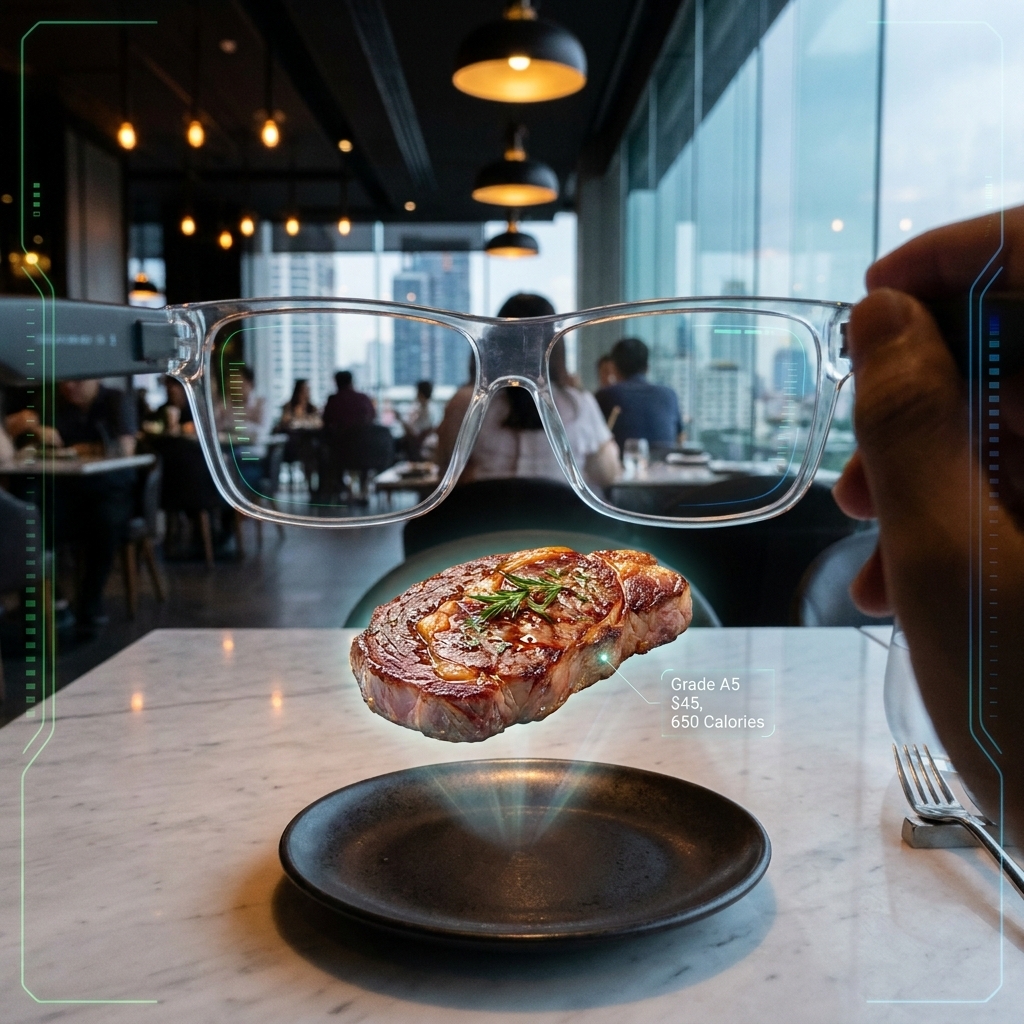
Visualizing the Dish: Pictures on an iPad are archaic. Soon, a customer will point their phone (or look through their AR glasses) at the empty table, and a hyper-realistic, 3D hologram of your signature dish will appear on the plate. They can see the portion size, the steam rising, and the texture of the sauce before they order.
The Strategy for Owners: You do not need to build a metaverse restaurant today. That is a waste of capital. However, you do need to start acquiring 3D assets of your menu. When you hire a photographer for your next menu shoot, hire someone who also does photogrammetry (3D scanning).
Own the 3D assets of your food now, so when the major platforms (Google Maps, Yelp, Wongnai) roll out AR menus, your F&B Digital Marketing infrastructure is ready to upload them instantly, crushing competitors who only have flat JPEGs.
Block Quotes: The Analyst’s View
"The danger of Marketing 7.0 is that average restaurants will try to out-robot the robots. You cannot. Your competitive advantage is not your technology; your technology is just the bridge. Your competitive advantage remains your humanity." — Ni Htoo Kyaw, F&B Digital Marketing Strategist
Concept 5: The "Human Premium" (Your Antidote to Automation)
This is the most crucial part of this entire guide.
As a Strategist, I spend my days building automated funnels, analyzing data, and optimizing algorithms. I am telling you to embrace the technology.
But I am also telling you: Do not lose your soul.
Marketing 7.0 creates a massive psychological reaction in consumers. As their lives become increasingly automated, algorithmic, and machine-driven, they will begin to crave genuine, unscalable human interaction.
I call this the "Human Premium."
When an AI books the table, an AI cooks the fries, and a QR code takes the payment, the actual human beings in your restaurant become your most valuable marketing assets.
How to market the Human Premium:
- The "Flawed" Content: As we discussed in our Social Commerce & Retail strategy, stop posting perfectly polished corporate videos. AI can generate a perfect picture of a steak. It cannot generate the sweaty, passionate, exhausted smile of your Head Chef at 11:30 PM after a flawless service.
- Micro-Hospitality: Train your staff to do things algorithms cannot. An algorithm can remember a birthday. A human server can notice a guest looks stressed, bring them a complimentary cup of chamomile tea, and say, "Long day? This is on the house."
In Marketing 7.0, your F&B Digital Marketing must be completely split in two:
- The Backend: Cold, highly structured, coded data designed entirely to appease the Machine Customer and AI Search bots.
- The Frontend: Warm, raw, deeply emotional storytelling designed to remind human beings that real people are cooking their food.
The Practical Playbook: How to Prepare for 7.0 on Monday Morning
Theory is useless without execution. Here is exactly what you need to do to prepare your restaurant for the Autonomous era, starting next week.
Phase 1: The Data Audit (Days 1-15)
- Stop Using PDFs: If your menu on your website is a PDF, delete it immediately. Build a native HTML page for your menu.
- Implement Schema: Hire a developer (or agency) to inject
Menu, MenuItem, and Restaurant Schema markup into your website’s code. This is how you "speak" to the AI bots.
- Consolidate NAP: Ensure your Name, Address, and Phone number are exactly identical across Google Business, Tripadvisor, Apple Maps, and your website. AI hates inconsistencies.
Phase 2: The CRM Engine (Days 15-30)
- Own the Data: Stop relying entirely on delivery apps that hide customer data from you. Build a direct booking and ordering system.
- Tagging: Start tagging customers in your CRM. (e.g., "Prefers Window Seat", "Allergic to Shellfish", "High LTV"). You cannot be predictive if you do not have historical data to predict from.
Phase 3: The Human Content Pivot (Days 30-45)
- Fire the "Aesthetic" Agency: Stop paying people to take boring, top-down photos of your food on a white table.
- Document, Don't Create: Give an iPhone to your sous-chef. Tell them to film the chaos, the mistakes, the supplier deliveries, and the recipe testing. Publish it raw. Show the humanity that the AI machines cannot replicate.
Conclusion: The Choice Ahead
The evolution of F&B Digital Marketing from 1.0 to 7.0 is simply a story of reduced friction. We went from handing out flyers, to buying banner ads, to targeting social feeds, to letting AI make the purchase for us.
The restaurants that fail in the next five years will be the ones who view marketing as an "art project." They will keep posting pretty pictures while the invisible algorithms route all the local wealth to their competitors.
The restaurants that thrive will be the ones who treat marketing as an engineering discipline. They will build the APIs, structure the data, and optimize for the Machine Customer, while preserving the raw, authentic hospitality that makes humans want to dine out in the first place.
You have the vision. Now you need the infrastructure.